Crime Denial at the New York Times, Part 1: Regarding the Torture of (Some) Others

The New York Times is the most important newspaper in America, and that is unfortunate, for in their pages, ordinary criminals are frequently treated with extreme deference and sympathy, even respect.  Some types of criminals are excluded from this kid-glove treatment, but that is a subject for another day.  For the most part, ordinary (property, drug, violent, sexual) criminals comprise a protected class in the Times.  Even when it must be acknowledged that someone has, in fact, committed a crime, the newsroom’s mission merely shifts to minimizing the culpability of the offender by other means.

There are various ways of doing this.  Some have to do with selectively criticizing the justice system: for example, the Times reports criminal appeals in detail without bothering to acknowledge congruent facts that support the prosecution and conviction.  They misrepresent the circumstances that lead to (sometimes, sometimes not) wrongful convictions while showing no curiosity about the exponentially higher rate of non-prosecution of crimes. ... 
Continue Reading →

Blogging Crime Versus “Disappearing” It: Chicago and Atlanta

Chicago:

In Chicago, something interesting is happening as “twittering” and blogging and e-mail bring in first-hand reports that deviate from official versions.  It is hard to whitewash incidents of violence and rioting when people are reporting them in real time and police are going back over their incident reports to compare notes later. ... 

Continue Reading →

The New Normal: Atlanta

I, for one, think newspapers are being rejuvenated by their current financial crisis.  The old-fashioned, insular newsroom, with its disturbing status quo on crime reporting (defendants are victims of society; victims are society, and thereby guilty of something) is becoming a thing of the past.

Over the holiday weekend, the Atlanta Journal Constitution ran this must-read story by Bill Torpy, in which he examines the real costs of retail burglaries for small business owners: ... 

Continue Reading →

“National Network for Safe Communities” or More of the Same Old Song?

The newest hot thing in crime reduction is actually an old idea that has been tried again and again, at staggering cost, with little objective evaluation of the results.  It is now being re-packaged as an initiative called National Network for Safe Communities, and several large cities are already signing on.  The idea is to “reach out” to the most prolific criminals, the ones who control drug dealing and gang activities, and try to engage them in dialogue to get them to stop dealing, robbing, and shooting — before threatening them with prison.

To put it another way, cities overwhelmed by crime will hand over yet another get-out-of-jail-free card to offenders who already, in reality, have fistfuls of them.  Cities will reinforce the status and egos of the worst offenders by engaging them in “dialogue”  (predictably, some of these offenders will simply use their new status to grow their criminal enterprise, like this M-13 gang member/executive director of Homies Unidos, a “nationally recognized anti-gang group”).  Cities will create and subsidize larger numbers of expensive, redundant, slush-fund “job outreach programs” and “youth intervention initiatives” and “community summits” and “lock-downs service provision weekends” — more, that is, than even exist now. ... 

Continue Reading →

An Important Law Georgia Still Does Not Have: Arrestee DNA Databasing

Back in the 1990’s, Georgia Lt. Governor Mark Taylor made it a priority to build the state’s DNA crime database.  He did this long before other states got on board, and for many years Georgia was rightly viewed as a leader in using DNA to solve violent crimes.  Taylor was driven by his strong commitment to victims of rape and child molestation who had been denied justice.  He did not heed the civil rights and convict rights lobbies who tried to stir up hysteria over using DNA to solve crimes (ironically, these same activists are howling over the Supreme Court’s utterly reasonable decision last week not to enshrine post-conviction DNA as a blanket, federal right, when 46 states already guarantee it, as even Barry Scheck admits: don’t believe virtually anything you read about this case on the editorial pages).

Taylor’s leadership on DNA databasing yielded an extraordinary number of database “hits” long before other states got their databases up and running.  In 1998, only convicted and incarcerated sex offenders were required to submit DNA samples in Georgia, yet 13 repeat-offender rapists were immediately linked to other sexual assaults, and scores of “unidentified offender” profiles were readied to be used if those offenders were finally caught and tested. ... 

Continue Reading →

Chilling Undercounting of Crime

At the Investigative Reporters and Editors’ Conference, Ted Gest from Crime and Justice News had some interesting things to say about crime under-reporting.  Murder statistics are usually considered the gold standard, statistically, since it’s hard to misplace a body.  But maybe not so hard, since Detroit managed to “lose” 100 of them last year:

Contrary to FBI statistics, more than 100 Detroit homicides were left off the books last year, Wayne County Prosecutor Kym Worthy told the Detroit Free Press. Worthy said the Detroit Police Department underreported that 306 people were killed in 2008. She said the homicide number is actually 423. ... 

Continue Reading →

Five Ugly Pieces, Part 2: Hiding In Plain Sight

The MySpace Page (thanks, to Grayson) of the “30 Deep Gang” is, according to the creator, “all about money.”  There are images of dice, diamonds, blocks of gold, rap stars, and twenty dollar bills.  There is a photograph of a young man pointing a gun at the camera, and another photo labeled “Lil’ Wayne . . . Prostitute Flange” showing a smiling woman towering over the rap star.  In the “friends” section, there is a picture of a young man with the caption, “Zone 3 shawty money men da longway.”  Zone 3 is where bartender John Henderson was murdered, and the police are looking for “30 Deep Gang” members in Henderson’s death.

Zone 3 is also where I used to live, and the sound of gunfire was a regular thing there.  In order to get by you had to ration your response to it, or you would spend every day responding to it, which is an impossibility.  This is what the mayor and the chief of police are denying whenever they announce that residents are being hysterical about crime.  Residents police themselves, even more than criminals are policed.   Innocent people are held captive by the threat of violent crime, but, still, there are people who believe it is distasteful to demand to be freed. ... 

Continue Reading →

“Defendants Have the Right to Remain Silent. . . Victims Have the Right to be Heard”

I found this quote on the website for the Larimer County, Colorado District Attorney’s office. It is a neat sentiment: well-intentioned, not overly ambitious. It is, in other words, a fitting description of the aims of victims’ rights laws.

It is also utterly untrue. ... 

Continue Reading →

The “Benjy Brigade”, Part 1: Boston’s Finest Mount an Attack on an Elderly Victim of Rape

The theme this week is punitive attitudes towards victims of crime. At the most primal level, the mere existence of victims threatens to spoil all the fun that can be had as you lift your glass from the tray, turn to Professor Ponytail (who could dress better at these things), and say: “When I was mentoring at the federal pen last weekend I met the most inspirational young author — wrongly convicted, of course — we must do something about getting his poetry published. We must!”

Oh, the headiness. That Seventies Susan Sarandon vibe, edgy alchemy of righteousness and rebellion — what a shame if it were all interrupted by flashing on the pensioner in her wheelchair in ugly tan compression stockings, rope scars on her wrists from where the young poet had bound her so tightly the paramedics had to peel the phone cord out from under layers of swollen skin. ... 

Continue Reading →

Meanwhile, In the Groves of Academe and the Forests of Newsprint

There’s no such thing as a crime problem. It’s just a perception problem, you silly hysterics. From the Houston Chronicle, which wants you to know that daring to be worried about crime is the only crime problem that matters:

In the words of a statistician, the decrease in criminality appears to have an inverse relationship, at least for now, with political rhetoric on crime, which has ramped up in recent months. ... 

Continue Reading →

Vengeance or Injustice: Which Problem is Real?

From Nicholas Kristof, in Friday’s New York Times:

[W]hile we have breakthrough DNA technologies to find culprits and exculpate innocent suspects, we aren’t using them properly — and those who work in this field believe the reason is an underlying doubt about the seriousness of some rape cases. In short, this isn’t justice; it’s indifference. ... 

Continue Reading →

Mission Creep: Burglars With Drug Problems. And Drug Courts With Burglar Problems. And Reporters With Truthiness Problems.

Atlanta is not the only city where recidivists with long records of serious crime are being permitted to avoid jail sentences because they are also drug addicts. From the Ithaca Journal, Ithaca, New York:

In a plea deal with prosecutors, a Groton woman charged with taking part in burglaries in three counties has been sentenced to time served, five years probation and ordered to attend drug court for local crimes. ... 

Continue Reading →

Jean Valjean, Selling Crack to Pay Child Support?

The economy may be declining, but the marketplace of improbable claims is doing just fine. In this story from the ew York Times, a neighborhood advocate in Columbia, South Carolina, claims that the bad economy is driving men to sell drugs in order to meet their child support obligations:

“Why can’t we get a step up in patrol?” asked Mary Myers, president of the tenant association at the Gable Oaks apartment complex in the northern part of the city, condemning what she says is a marked increase in drug dealing and gang-related violence in recent weeks. ... 

Continue Reading →

Justice Delayed + Tax Dollars Wasted = Justice System Starved

Apparently, while it may be hard to be a pimp, as the popular song goes, it isn’t particularly hard to be a defendant in a child molestation case:

DragonCon founder’s health might keep him from standing trial

Edward Kramer was charged in 2000 with molestation children

The Atlanta Journal-Constitution ... 

Continue Reading →

Don’t Believe Everything You Read

So it turns out that Eric Harris and Dylan Klebold weren’t bullied, just psychotic. Now we can gather up all the blame that’s been spread out among the victims and society at large and deposit it firmly where it belongs: on the killers.

Will the well-funded anti-bullying industry, which has been profiting from Harris and Klebold’s murders for a decade now, edit their workbooks and return the money now? ... 

Continue Reading →

Here’s Why I Loved Reading the St. Petersburg Times When I Was in College

The St. Pete Times has recently begun running a “mugshot” feature, like the ones published in cheap tabloid form and sold in convenience stores.  It’s a sad day for that institution (the Times, not convenience stores).

Here is the type of reporting for which the Times used to be routinely known.  It offers real insight into a tragic crime and –unlike so much reflexively pro-criminal reporting, like this disturbing L.A. Times whitewash — explores the price innocent people pay for our collective failure to put criminals away: ... 

Continue Reading →

Criminologists Say the Craziest Things, Part 4: The Economy Made Me Kill, or, Don’t Believe Everything the Crazy Guy With The Gun Says.

I realize I beat this like a dead horse the other day, but the experts are beating it like two dead horses, as evinced by this article in the Washington Post: “Some Link Economy With Spate of Killings.”  The “some” mentioned here is the same “some” mentioned in the Christian Science Monitor, noted criminologist Jack Levin, along with fellow noted Northwestern criminologist James Alan Fox.  But being noted doesn’t mean that you can’t be wrong.  It’s utterly risible to lump together these 57 murders and attribute them to the economic crash.  In fairness, it’s the journalist here who makes this claim, but Levin and Fox eagerly embroider on it:

Comparative statistics are difficult to come by, but during the past month alone, at least eight mass homicides in this country have claimed the lives of 57 people. Just yesterday, four people were discovered shot to death in a modest wood-frame home in a remote Alabama town. ... 

Continue Reading →

Criminologists Say the Craziest Things, Part 2: Man Bites Dog. Dow Jones Implicated.

Yesterday, I wrote about some media reactions to the Binghamton mass killer.   Today, I want to take a closer look at the ways expert opinions play out in one article about recent mass killings from The Christian Science Monitor.  

In “Shootings, Murder-Suicide Raise Broader Question: Is Violence Linked to Recession?”, writer Patrik Jonsson posits the theory that the recent economic downturn may be responsible for the following crimes: ... 

Continue Reading →

Criminologists Say The Craziest Things, Part 1: Spree Killings

The Christian Science Monitor, The New York Times, and other American papers with international readership frequently package stories about the horrors of America to feed the America-bashing appetites of their international audiences.  They are generously abetted in this mission by academic criminologists who stand at the ready to paint a dystopic picture of an America peopled with violent, bloated drones dragging their automatic weapons behind them as they traverse the soul-less space between their pickup cabs and the big box store.

Such stories are morality tales — the moral being that virtually everybody — except real criminals — are the real crime problem in America.  We are bad; gun-toting offenders are merely impulsive creatures channeling our rage. ... 

Continue Reading →

What Do You Call A Sex Offender Free on the Streets of Tampa Bay? Doctor. Or Nurse. Or Fodder for St. Petersburg Times Columnist Daniel Ruth to Crack Sex Jokes.

Maybe I’m just touchy because this neck of the woods is not far from where my own rapist traipsed in and out of prison for twenty-plus years, but what precisely does it take to get sitting judges (not to mention certain journalists) in Tampa Bay to take the threat posed by sexual predators seriously?  

First there’s Dr. Rory P. Doyle, who fled the Tampa Bay area after a judge permitted him to go free on bail after being charged with two counts of child molestation.  Astonishingly, Doyle is being treated to similarly indulgent judicial scrutiny in Ireland, where he has again been released to the streets while awaiting extradition hearings.  Then there’s nurse Richard Chotiner, who was released on bail pending an appeal that could take months, or years, after being convicted of lewd and lascivious battery of a mentally-disabled 23-year old.  Chotiner was released without electronic monitoring by Hillsborough Circuit Judge J. Rogers Padgett.  Releasing Chiotiner without considering public safety is especially egregious when you consider the details of the crime for which the nurse was convicted: ... 

Continue Reading →

Article on Atlanta Crime in the Chicago Tribune

An interesting article in the Chicago Tribune today, about Atlanta’s drug gangs: “Mexican Drug Cartels Spreading Roots in Atlanta”:

Atlanta, with its prime location for easy distribution, has become a major hub for drug trafficking by the cartels and a principal distribution center for wholesale-level cocaine, methamphetamine and marijuana to the eastern United States, U.S. Drug Enforcement Administration officials said. In 2008, Atlanta led the nation with $70 million in confiscated cash, according to the DEA. That is more than double the $32 million seized in Chicago in 2008. ... 

Continue Reading →

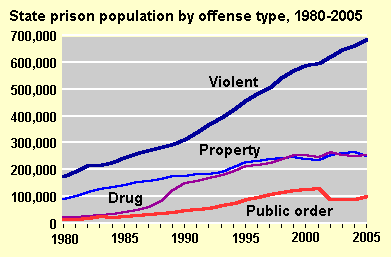
More Americans in Prison Than (fill in the blank). Here’s the Unasked Question: Why Do We Have So Many More Criminals Committing So Much Crime?

In merely the latest of an endless series of proclamations that we must do something to get our prison population in line with other countries’, Republican Senator Arlen Specter and Democratic Senator Jim Webb have teamed up to create a blue-ribbon panel to rehash the usual themes: reducing levels of drug criminalization, freeing the mentally ill from jails, exploring alternatives to sentencing, and enhancing prisoner re-entry services.  Their goal is to reduce the prevalence of prosecutions so that our incarceration statistics come to resemble statistics in European nations.  Of course, crime, especially violent crime, is vastly more prevalent here; thus, higher rates of incarceration.  But that subject is verboten.  Efforts to avoid acknowledging crime in a discussion about responses to crime lead to convoluted statements like the following:

We are doing something drastically wrong,” said Webb, whose plan also aims to improve the US response to armed gangs, especially drug-related groups, as it seeks to bring the prison population down from about 2.4 million people. ... 

Continue Reading →

Dumbing Down Justice: The New York Times Reports One Side of the Anti-Incarceration Controversy, Again

Under the guise of news, the nation’s “Paper of Record,” The New York Times, is reporting on controversial efforts to release more offenders early or to not imprison them at all — as if there is no controversy and everybody simply agrees that letting recidivists loose early will save money, not cost money and endanger the public.

In an article titled, “To Cut Costs, States Relax Prison Policies,” the Times uncritically quotes both the Pew Center for the States and the Center for Effective Public Policy — and nobody else.  But these organizations fail to count in their analyses the added costs of crimes committed by offenders who would otherwise be incarcerated at the time they re-offend. ... 

Continue Reading →

Another (Wannabe) California Cop Killer, and Her Apologists: Sarah Jane Olson and Ruben Rosario

As some in Berkley/Oakland and Austin, Texas celebrate the murders of four police officers by child-rapist Lovelle Mixon, the recent release of Sarah Jane Olson, fugitive, murderer, attempted cop killer and Weather Underground activist should remind us of the origins of the sentiment “kill the pigs.”

Well-off radicals like Olson descended on poor communities in Oakland in the late Sixties, when it was hip to do so, and fomented violence there in the name of “revolution.”  When the wretched stakes for real community members wore out their welcome, these itinerant revolutionaries trotted back to their to upper-class enclaves, leaving conditions in the impoverished, urban, minority neighborhoods much worse than they found them. ... 

Continue Reading →

More On The Oakland Police Killings

In an article purportedly about Lovelle Mixon’s criminal record (he has been linked to one rape through DNA and is being investigated in another), the San Francisco Chronicle inexplicably chose to give the deceased quadruple murderer several column inches to assert his innocence, good intentions, and career goals.  He apparently thought he was a pretty good guy, carjackings, attempted murders, and sundry crimes notwithstanding:

Mixon’s version

Mixon told authorities that in the attempted carjacking, “I was in the wrong place at the wrong time and did not act responsible and allowed someone else to act just as bad,” according to the report. “Now I have to take responsibility for it all.” ... 

Continue Reading →

“What Went Wrong” in the Murder of Four Oakland, CA Police [Update #1, Below, 3/24]

Yesterday morning, the San Francisco Chronicle ran a story about “what went wrong” in the quadruple murder of police officers in Oakland, California.  The focus of that story was police procedure — an understandable line of inquiry with four policemen’s lives lost at two crime scenes.  Today, both the Chronicle and the Los Angeles Times ran stories covering the problems that arise when violent offenders like Lovelle Mixon, the man who killed the officers, are released on parole.

The Chronicle, however, starts every story by stressing how rare it is that parolees resort to violence.  And, of course, killing four officers is a thankfully rare tragedy.  But, as the Chronicle itself notes, fully two-thirds of California parolees are returned to prison for violating parole.  That’s two-thirds of the state’s 122,000 parolees.  Is violence really “rare” in this vast group of offenders?  Why do some newspapers reflexively minimize such horrific numbers, particularly in the immediate aftermath of the murder of four policemen?  There are more than 16,000 parolees in California currently wanted for parole violations.  12% of parolees in California abscond immediately upon leaving prison.   ... 

Continue Reading →

What Is Your Personal “Aggregate Burden of Crime”?

On Tuesday, I wrote about the debate that’s raging over incarcerating convicts or releasing them to “community sentencing” programs of one type or another.  Proponents of community or alternative sentencing argue that we save tax dollars when people convicted of crimes get to stay at home for therapeutic or rehabilitative interventions instead of being removed from the community and sentenced to prison terms.  ... 

Continue Reading →